
A brisbane gutter guard assessment checklist should help you spot visible blockages, water bypass, loose or damaged sections, and signs that a closer inspection is needed. Work from the ground where possible, record what you can see, then decide whether to monitor the area, arrange cleaning, or get a suitable professional to assess it. This approach gives homeowners, landlords and property managers a practical record without treating a guard as proof that the gutter is clear.
Step 1: Set a safe scope before inspecting
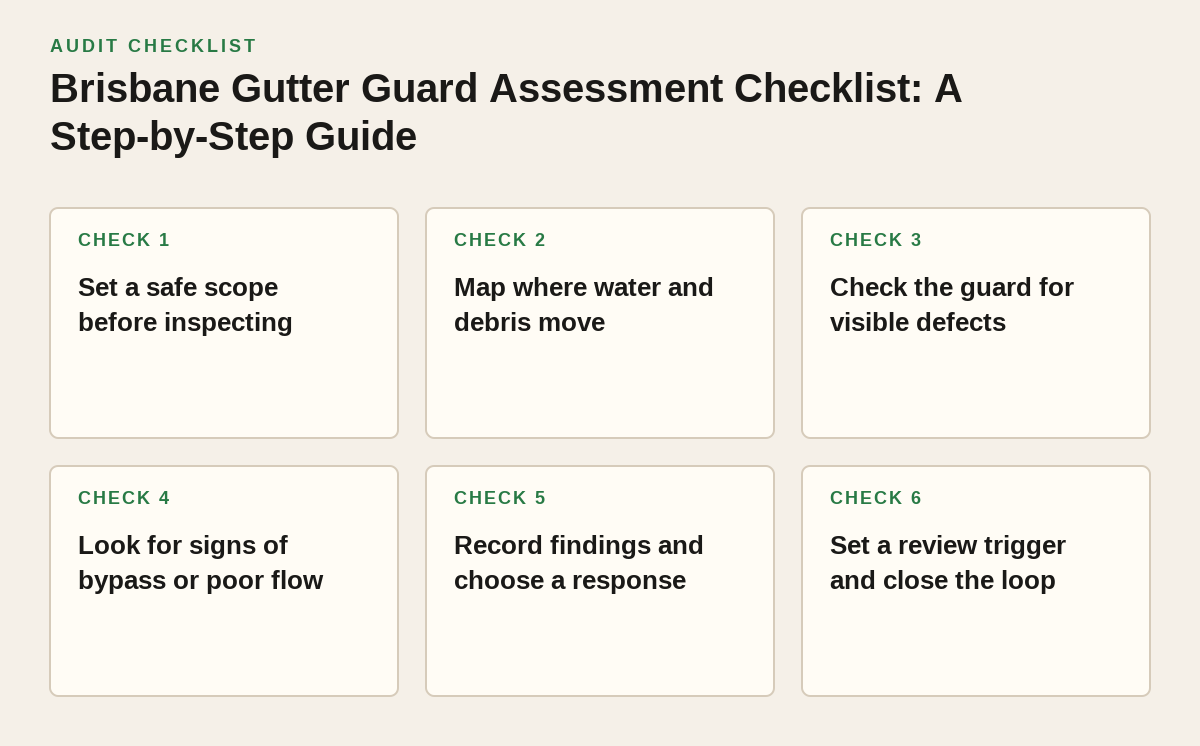
Start by deciding what the assessment can establish. A ground-level check can identify visible concerns; it cannot confirm the condition of concealed gutters, fixings or roof edges. Do not climb onto a roof or reach over a height to inspect a guard. If you cannot see an area safely, record it as not inspected rather than guessing.
Choose a safe viewing position
Walk around the property on stable ground and look from positions where the roof edge is visible. Avoid inspecting during rain, strong wind, or when surfaces are wet. Queensland’s ladder safety guidance outlines fall risks and safe ladder practices; if access would require a ladder and you are unsure how to use it safely, leave that part to a competent person rather than improvising (WorkSafe Queensland ladder safety).
- Note the property address, inspection date and who completed the check.
- Identify areas hidden by trees, roof shape, adjoining buildings or limited access.
- Keep tenants, visitors and staff away from any area where debris may fall.
- Photograph concerns from a safe position; do not climb to get a better image.
Record limitations plainly. For a rental or strata property, this prevents a ground-level observation from being mistaken for a full roof inspection.
Step 2: Map where water and debris move
Before judging the guard, identify the parts of the system you can see: roof edges, gutter runs, corners, valleys, downpipe openings and the points where water exits. The aim is to follow the likely path of leaves and runoff, not to diagnose hidden drainage faults. A guard may look intact along a straight run while a corner, valley or downpipe opening remains exposed.
Make a simple property map
Use a quick sketch or a set of labelled photos. Mark each roof side and note nearby trees, overhanging branches, roof valleys, visible downpipes and places where the gutter line disappears from view. If you are managing several units, use the same labels on every inspection so a contractor or committee can match notes to the right elevation.
- Tree side: note branches that hang above the roof or gutter.
- Junctions: mark corners, valleys and changes in roof direction.
- Outlets: locate visible downpipes and any exposed inlet openings.
- Blind spots: identify sections that cannot be assessed from the ground.
Queensland Government storm-preparation advice is a useful reminder to include roof drainage in property readiness, rather than checking only after water has entered a building (Queensland Government: prepare your home). Use the map to focus attention on likely debris collection points, not as a substitute for checking the whole accessible perimeter.
Step 3: Check the guard for visible defects
Look for changes in the guard’s position or surface. From the ground, scan for sections that appear lifted, sagging, displaced, bent or separated from adjoining sections. Also note visible gaps at corners, roof valleys and around outlets. These are observations, not proof of the cause: wind, debris, ageing materials or earlier work may all need closer examination.
Separate visible condition from assumed cause
Write “section appears raised near rear corner” rather than “storm damage” unless the cause is known. That distinction helps owners and property managers request the right follow-up without turning a visual check into a diagnosis. Do not pull at the guard or poke debris through it; that can shift components or move material into the gutter.
Record whether the concern is isolated or repeated along a run. A single visible gap may call for a focused check, while multiple displaced sections suggest the whole run needs assessment. Do not assume a guard eliminates maintenance. Debris can collect on top of a guard, pass through openings, or gather at transitions and outlets.
Step 4: Look for signs of bypass or poor flow
Assess what happens around the gutter during or after rainfall only from a safe place. Look for water spilling over the edge, staining below the gutter, damp marks near walls, or debris visibly caught at an outlet. These signs can indicate that water is not moving as intended, but they do not by themselves identify whether the cause is a blocked outlet, a damaged section, roof runoff, or another drainage issue.
Check for evidence in more than one place: a stain below a corner, for example, is more useful when matched with a photo of the nearby gutter run and outlet. Brisbane City Council’s information on stormwater drainage explains the role of drainage around properties; use it as local context when deciding whether an observed issue may extend beyond the gutter itself (Brisbane City Council stormwater drainage).
- Note where overflow or staining appears and whether it is below a joint, corner or outlet.
- Record visible leaves, seed pods or other debris sitting on or beside the guard.
- Compare the location with your property map; note if the same point has come up before.
- If water is entering the building or damage appears active, arrange prompt assessment rather than waiting for a routine check.
Step 5: Record findings and choose a response
A useful assessment turns observations into a clear next action. Use consistent labels such as monitor, cleaning assessment, and repair assessment. These are practical categories, not technical ratings: choose the category that reflects what you can see, and ask a qualified or suitably experienced professional to assess anything that needs access or diagnosis.
| Observation | What to record | Practical next step |
|---|---|---|
| Guard looks in place; no visible debris or overflow | Area checked, date and any blind spots | Keep the record and check again after relevant weather or when concerns arise. |
| Leaves or buildup visible on or near the guard | Exact run, nearby trees, outlet visibility and photos | Arrange an assessment to determine whether cleaning is needed. |
| Guard looks lifted, bent or separated | Location, extent and whether adjoining sections appear affected | Request a closer condition assessment; avoid trying to refit it yourself. |
| Overflow, staining or dampness visible | Where it occurs and any related outlet or joint observations | Ask for the drainage issue to be assessed; do not assume the guard is the only cause. |
Worked example: a rental home below a tree
Imagine a property manager sees leaf buildup above a rear gutter and a stain below one corner. The useful record is not simply “gutter blocked.” It notes the rear elevation, the nearby tree, the visible buildup, the stain’s position and whether the outlet can be seen from the ground. The manager can then request a cleaning assessment and ask for the corner and outlet to be checked. If the area is hidden, the record says so instead of implying it was cleared.
For a body corporate, attach the location map and photos to the maintenance request, then record who is responsible for approving access and follow-up. That keeps the discussion focused on the observed problem and the next decision, not competing assumptions about the cause.
Step 6: Set a review trigger and close the loop
Do not rely on a calendar alone. Set a review trigger that suits the property’s exposure: for example, after a significant storm, when nearby trees shed heavily, after a reported overflow, or when a maintenance contractor identifies a concern. Queensland’s disaster-preparation advice and the Bureau of Meteorology’s warning information can help property managers plan checks around local conditions, but neither replaces an inspection of the actual gutter and guard (Bureau of Meteorology Queensland warnings).
Any numeric interval you choose should be labelled an illustrative starting policy, not a universal rule. Adjust it if records show recurring buildup, overflow, guard movement or changing tree cover; lengthen or simplify the routine only when repeated observations support that decision. The signal to change the policy is evidence from the property, not a generic schedule.
For broader exterior upkeep, landlords preparing a home for a tenancy change may also want to plan residential window cleaning brisbane or review window cleaning brisbane separately; those jobs do not replace gutter assessment.
What to do first: make the property map
Start by walking the accessible perimeter from the ground and marking roof edges, visible outlets, tree exposure and blind spots. Take clear photos of any concern, label what you could not inspect, and use the table to choose the next action. Brisbane Window Cleaning & Solar Panel Cleaning offers gutter cleaning, including homes with gutter guards fitted; if the record points to a closer assessment, see Brisbane Window Cleaning & Solar Panel Cleaning for details.
Book a Brisbane gutter clean
Brisbane Window & Solar Panel Cleaning: a local team with 15+ years in Brisbane, police-checked and fully insured ($20M). Bundle any two services and save 10%.
Gutter cleaning Brisbane | Residential gutter cleaning | Northside, Redcliffe & North Lakes | Gutter cleaning quote & prices | Call 07 2145 5260
Authored with NotFair SEO